
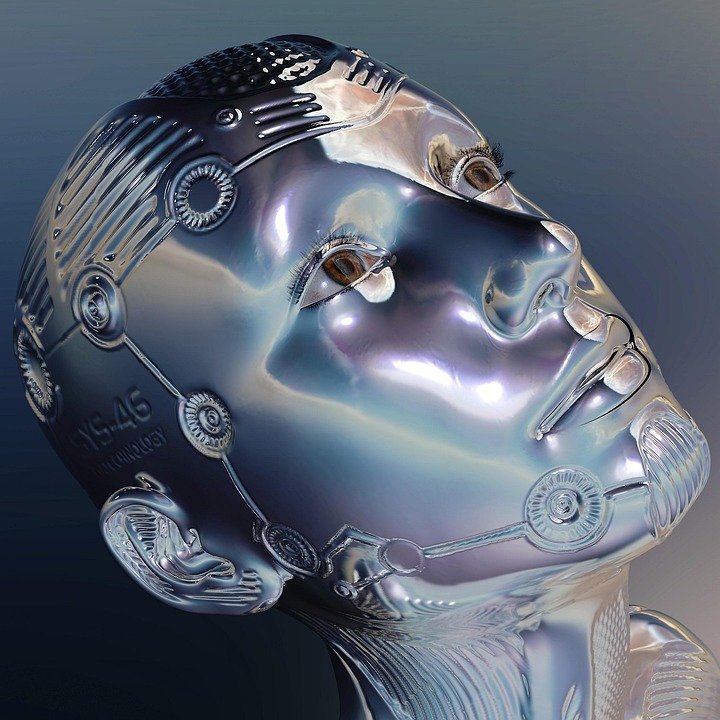
When Imagination Became an Engine
Someone in the 1940s had said a phone could write poetry or draw portraits, people would have laughed.And yet here we are.
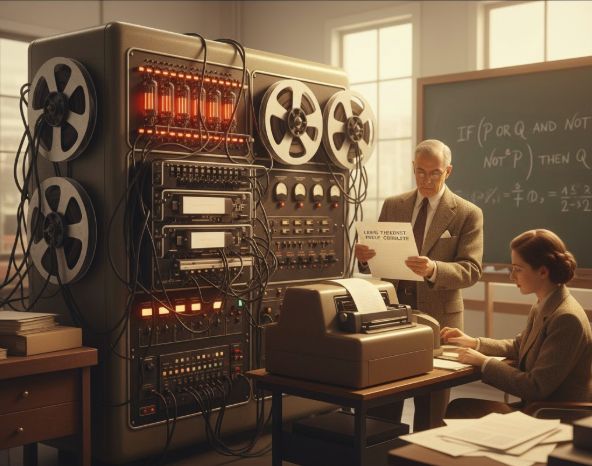
Artificial intelligence didn’t fall from the sky.
It’s the result of hundreds of years of people chasing a question that refuses to die:
What exactly is intelligence, and could we ever build it?
This isn’t really a story about computers.
It’s a story about the people who couldn’t stop wondering.
Long Before Circuits
Thousands of years ago, Aristotle sat in Greece trying to explain how humans reasoned.
He believed every decision followed a pattern — logic before emotion.
That single thought planted the seed for what would, centuries later, become algorithms.
By the 1600s, inventors like Blaise Pascal and Gottfried Leibniz were twisting gears and levers into early calculators.
They were slow, noisy, and unreliable, but the idea was intoxicating: a machine could think through numbers.
Leibniz even imagined a universal language that could express truth mathematically.
Wild? Maybe. But that’s where AI really began — in a dream, not a laboratory.
The Man Who Asked the Right Question
Then came Alan Turing.
During World War II, while others were fighting on the front lines, Turing was decoding messages and, unknowingly, building the foundation for modern computing.
After the war he asked a question that made scientists uncomfortable:
“Can machines think?”
He proposed a test. If you spoke to a computer and couldn’t tell it wasn’t human, maybe it was, in some sense, intelligent.
It was half philosophy, half challenge — and it lit a fuse that’s still burning.
1956: When AI Got Its Name
Summer 1956, Dartmouth College.
A small group of scientists met for a six-week workshop that would quietly change everything.
They called their new idea Artificial Intelligence.
For a few glorious years, hope ran wild.
Programs solved math puzzles and played checkers; researchers predicted human-level reasoning within a generation.
Then reality hit.
Computers were weak, data scarce, optimism expensive.
By the late ’70s, AI went cold — the first AI winter.
The Quiet Years
Funding disappeared, but curiosity didn’t.
A few stubborn researchers kept working, convinced machines could learn if given examples instead of instructions.
They were right; it just took time and faster hardware.
The 1980s: Machines That Learn
In the 1980s, “machine learning” entered the scene.
Instead of scripting every rule, scientists built neural networks that adjusted themselves through trial and error.
It was messy — computers misread handwriting, confused cats with dogs — but it worked well enough to keep hope alive.
AI was learning but not memorizing.
That small shift changed the entire future.
1997: Deep Blue’s Checkmate
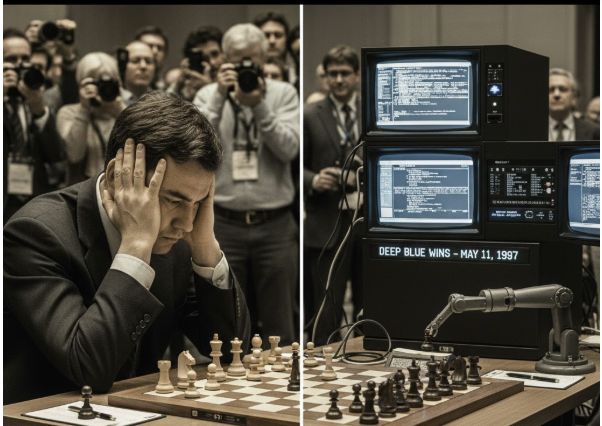
When IBM’s Deep Blue defeated chess grandmaster Garry Kasparov, the world gasped.
A lump of metal and wires had beaten a genius.
Deep Blue didn’t feel victory; it simply calculated millions of possibilities per second.
But to many, that was close enough.
For the first time, humans realized intellect might not need consciousness to exist.
The Internet Gives AI Its Fuel
Then the world went online.
Every search, selfie, and song streamed into servers became food for algorithms.
Data — mountains of it — gave AI memory.
Search engines learned our habits.
Shopping sites predicted what we’d buy.
Social media quietly learned who we were.
AI stopped being a science project and became part of daily life, humming behind every screen.
The 2010s: Eyes, Ears, and Instinct
By 2012, computing power had exploded.
A model named AlexNet shocked researchers by recognizing photos almost as accurately as people.
Suddenly, computers could see.
Soon they could listen, too.
Siri, Alexa, and Google Assistant entered our homes, answering questions, telling jokes, occasionally misunderstanding us like an impatient friend.
Then AlphaGo arrived (2016) and defeated the best human Go player alive — a game thought too complex for machines.
AlphaGo learned strategy by playing itself millions of times.
It wasn’t following human ideas; it was inventing its own.
The 2020s: When AI Became an Artist
And then came the wild part — Generative AI.
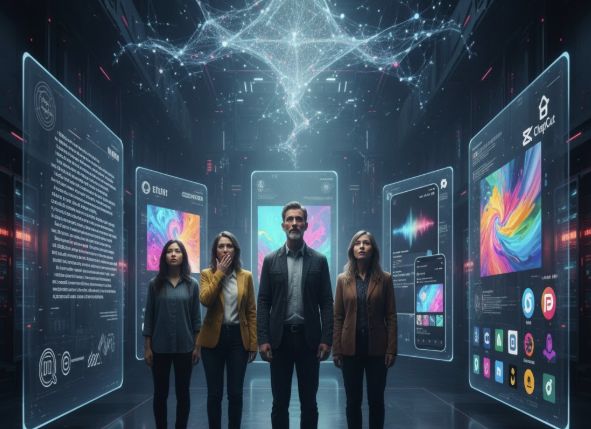
Ask it to write a story, and it writes one.
Ask it to paint, and it paints.
Ask it to design an app, a song, a logo — done.
Tools like ChatGPT, Midjourney, and Gemini blurred the line between creator and creation.
Suddenly, AI wasn’t just analyzing the world.
It was adding to it.
For some, that felt magical.
For others, terrifying.
Either way, it changed everything.
The Other Side of Genius
Of course, power always brings trouble.
AI can make life easier or deeply complicated.
Who owns AI-generated art?
What happens when algorithms echo our prejudices?
And how do we keep misinformation from spreading faster than truth?
AI mirrors us — brilliant, flawed, unpredictable.
It learns whatever we teach it, even the things we’d rather forget.
Humans and Machines Together
Despite the noise, the real future isn’t man versus machine — it’s the two working together.
Doctors use AI to spot cancers earlier.
Teachers use it to tailor lessons.
Farmers predict rain, drivers avoid accidents, writers find inspiration.
AI amplifies human ability. It doesn’t replace human meaning.
The best results happen when heart and hardware work side by side.
What Comes Next
1. Emotionally Aware AI – machines that read tone and body language to respond more naturally.
2. AI in Medicine – predicting diseases before symptoms appear.
3. Creative Partnerships – humans and algorithms co-creating music, film, and design.
4. Autonomous Systems – cars, drones, and cities that manage themselves.
5. Artificial General Intelligence – the dream (or fear) of an AI that truly understands the world.
No one knows when AGI will arrive — or what happens after it does.
What Makes Us Different
As AI grows smarter, it reminds us of something important: thinking isn’t the same as understanding.
Machines can calculate love songs, but they don’t fall in love.
They can describe grief, but they don’t feel it.
The more we build intelligence in silicon, the more we value the one made of emotion and memory.
The Real Lesson
From Aristotle’s chalkboard to Turing’s code to today’s neural networks, every step in this story was powered by human imagination.
We weren’t just building machines — we were exploring ourselves.
Every generation asked, “Can we make something smarter?”
And every answer brought a new question.
That’s what makes the evolution of AI so human.
It’s not about circuits learning to think; it’s about people learning what thinking really is.
A Story Still Being Written
Artificial Intelligence isn’t the end of the human story; it’s another chapter.
We’ve taught machines to learn, but they’ve taught us to reflect.
Maybe intelligence was never about data or speed.
Maybe it was about curiosity — the one thing a machine can’t fake.
Quick Timeline
| Era | Milestone | Impact |
|---|---|---|
| 1600s | Mechanical calculators | Logic takes physical form |
| 1940s | Alan Turing | “Can machines think?” becomes science |
| 1956 | Dartmouth Conference | AI officially born |
| 1970s | AI Winter | Hype fades, curiosity survives |
| 1980s | Machine Learning | Computers begin to adapt |
| 1997 | Deep Blue vs Kasparov | Machines outthink humans in logic |
| 2000s | Internet Era | Data becomes AI’s fuel |
| 2010s | Deep Learning & AlphaGo | Machines gain perception & intuition |
| 2020s | Generative AI | Machines start creating with us |
“We built machines to think. They reminded us to wonder.”