
If you’ve ever wondered how your phone recognizes your face in bad lighting, why your music app seems to know your mood, or how spam disappears from your inbox before you see it, you’ve already met Artificial Intelligence. Not the science-fiction version.
The everyday kind that quietly takes in data, learns a pattern, and makes a useful call. Think of AI as the reliable coworker who never sleeps, loves spreadsheets more than any human should, and gets better the more you show it.
A simple way to think about AI
Traditional software is a recipe. If this happens, do that.
AI is more like a cook who’s watched a thousand people make the dish, tasted the results, and adjusted the steps until the flavor is right. It’s still math under the hood, but instead of following fixed rules, the system learns those rules from examples. That’s the entire shift. We replaced hard instructions with learning from data.
So what does “intelligence” mean here
Not emotions, not consciousness. In AI, intelligence means being able to recognize patterns, make predictions, and choose actions that improve with experience. Spot the cat in the photo. Flag the fraudulent transaction. Suggest the next word in your sentence. None of that requires feelings. It requires lots of examples and a way to learn from mistakes.
Inputs, learning, outputs
Every AI system follows the same flow. Something comes in: a photo, a clip of audio, a block of text, a sensor reading from a camera or a car. The system processes it with an algorithm trained on past examples. Out comes a result: “this is a stop sign,” “route around traffic,” “recommend this movie,” “translate that sentence.” The key is the learning step in the middle. With feedback, the system tweaks its internal settings and tries again. Over time, it gets closer to the right answer more often.
Machine learning, in plain language
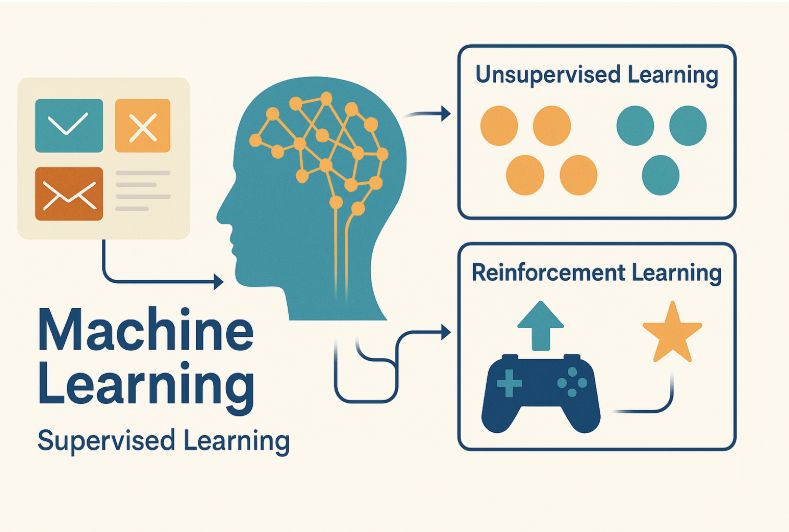
Machine learning is the part of AI that lets computers improve with practice. Show a model thousands of emails labeled spam and not spam, and it will learn what separates the two. Show it sales histories and it will forecast demand. Let it analyze recordings of people speaking and it will turn speech into text with fewer errors each week. The system isn’t memorizing one example at a time. It’s building a general sense of the pattern so it can handle new cases it has never seen.
There are a few common ways this learning happens. In supervised learning, examples come with answers. In unsupervised learning, there are no answers; the system groups similar things together on its own. In reinforcement learning, the system tries actions and gets rewards or penalties, like a game character that learns to win by playing millions of rounds.
Neural networks and why depth matters
Neural networks power most modern AI because they’re good at handling messy, real-world data like images, audio, and language. Picture layers of simple decision makers stacked on top of one another. The first layer in an image model might notice edges. The next layer sees simple shapes. Deeper layers pick up textures, then objects, then entire scenes. Each layer passes a cleaned-up signal to the next until the system can say, with confidence, “that’s a bicycle” or “that’s a melanoma.” When the stack has many layers, we call it deep learning. The depth lets the network build complex ideas from simple building blocks, the same way letters form words and words form sentences.
Training these networks is repetitive and precise. The model makes a guess, we compare it to the truth, measure the error, and nudge the network slightly to reduce that error. Do that millions of times. It’s not magic. It’s persistence and feedback at machine speed.
From raw data to a working model
Turning data into a useful AI model is more like gardening than construction. You don’t just build it and walk away. First you gather and clean the data so you’re not training on duplicates, noise, or missing values. Then you train, adjusting the model until it does well on examples it has seen. Next you test it on fresh examples it hasn’t seen to check for overconfidence. Finally you deploy it into the real world and watch how it behaves. That last step matters because reality drifts. The slang in social media changes. Scammers find new tricks. Cameras get better. Good AI isn’t static; it’s maintained.
Why the right data beats more data
People often say “more data wins.” More relevant, representative data wins. A face model trained mostly on one demographic will do worse on others. A medical model trained on one hospital’s equipment might fail across town. Fixing this is practical, not theoretical. You expand and balance your data, document how it was collected, and measure performance across different groups. If you find uneven errors, you correct them. Fairness starts at the dataset, not in a press release.
Where you meet AI every day

You see AI when your camera brightens a backlit photo without turning faces into ghosts. When your maps app warns that a crash twenty minutes ahead will cost you eleven minutes unless you take the next exit. When your bank flags a purchase you didn’t make. When your music app serves up a new artist that somehow feels familiar. At work, AI turns a messy meeting transcript into a clean summary. In a warehouse, it guides workers to the right shelf, cutting error rates. In clinics, it highlights suspicious regions on scans so specialists can focus on the right pixels first. The best of these systems don’t draw attention to themselves. They just shave seconds and stress from your day.
What AI is great at, and where it stumbles
AI shines at narrow tasks with clear goals and lots of history to learn from: ranking, sorting, classifying, translating, forecasting. It struggles when rules are fuzzy, data is scarce, or context matters more than patterns. A model can draft a helpful email, but it doesn’t know the delicate history behind the relationship. It can label a medical image, but it doesn’t understand what matters to the patient. Treating AI as a teammate keeps you out of trouble. Let it do the heavy lifting; you make the call.
How to evaluate AI claims without the hype
If someone tells you their model is 97 percent accurate, ask on what data, collected when, in which conditions, and compared to what baseline. Ask how often it’s retrained and what the system does when it’s unsure. Good products admit uncertainty, expose confidence scores, and hand tricky cases to humans. That’s not weakness. That’s how you keep mistakes small and fixable.
Bias, privacy, and responsibility
Bias isn’t a smudge you wipe off at the end. It flows from the world into the data and into the model unless you design the pipeline to catch it. That means curating datasets on purpose, auditing results across different groups, and watching for drift over time. Privacy has the same shape. Collect less by default. Keep computation on the device when you can. Encrypt what you must store and let people delete their data without a scavenger hunt. Responsibility is simple to say and hard to do: be clear when AI is involved, explain decisions in human terms, and make it easy to appeal an outcome. Trust grows when these basics are obvious.
Generative AI, explained without the buzzwords
Generative AI makes new content: drafts, images, code, even music. It learns the patterns in huge collections of examples and then produces something that fits those patterns. Used well, it’s a fast first draft, a brainstorming partner, a tireless explainer. It’s not a final editor and it’s not a moral compass. You point it at the right problem, set guardrails, and then you revise. That simple loop saves time without handing over judgment.
Why your devices are getting smarter on their own
More AI is running on phones, earbuds, and glasses. On-device models respond faster, work without a perfect signal, and keep sensitive data local. You’ll notice fewer spinning loaders and more tools that feel instant. That’s not just convenience. It’s a privacy win, too, because your voice, photos, and notes don’t have to leave your pocket for the device to help.
A practical way to start using AI wisely
Pick one repetitive task with a clear definition of “good.” Summarize calls. Triage support tickets. Draft routine replies. Measure your baseline, try an AI-assisted version for a week, and compare. If quality holds and time drops, keep it. If it’s close, tune your prompts or tighten the scope. If it isn’t helping, move on. The goal isn’t to sprinkle AI on everything. It’s to reclaim attention for work that only you can do.
Where this is headed next
AI is getting better at understanding mixed inputs: a diagram plus a paragraph plus a short voice command. Tools will feel more conversational and more aware of the task you’re in. You’ll see copilots woven into the software you already use, nudging you with suggestions that are specific, not generic. Jobs won’t vanish overnight, but job descriptions will bend. The skills that rise are the ones that guide AI: asking precise questions, checking outputs, adding context and taste, and knowing when to slow down and take the wheel.
The honest bottom line
Artificial Intelligence isn’t a mind. It’s pattern recognition, prediction, and generation at scale. It works best with good data, clear goals, and human oversight. It fails when we ask it to understand things we never showed it or when we treat guesses as gospel. Use AI like a strong teammate: have it draft, sort, and spot patterns; you bring judgment, empathy, and standards. That combination is where the real gains live—in calendars that feel lighter, decisions that come faster, and work that leaves you more time for the parts that actually need you.