
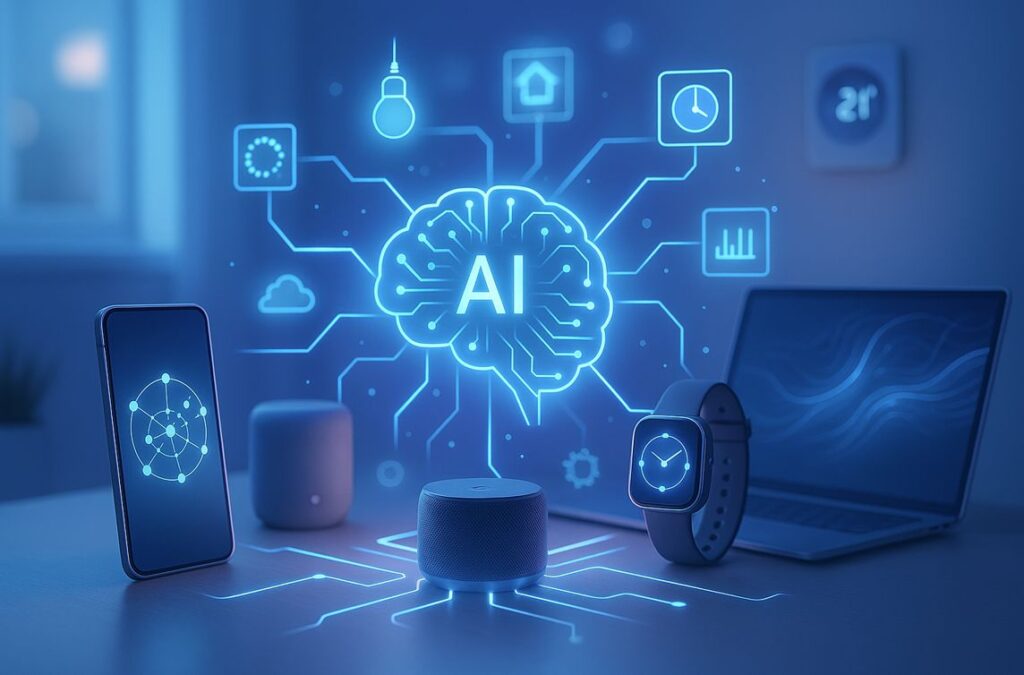
I’m writing this after a long day with my phone at 4% battery, which is funny because the phone still lasted. It learned when I usually plug in and quietly stretched the last few percent by slowing down background apps. That tiny moment says a lot about where we are with artificial intelligence and smart devices
AI is not a big robot marching into our lives. It’s like camera that fixes a dark room, the watch that nudges you to stand, the map that knows a road is crowded before you turn the corner. It sits in the background, taking notes, and tries to help.
When people say AI, they often mean the same thing: machines learning from data to make reasonable choices. Old software followed strict rules.
Modern AI watches what happens, spots patterns, and improves over time. The point isn’t to sound clever. The point is that technology now adapts. It meets you where you are instead of forcing you to tap through ten menus for a simple thing.
What AI Means in modern life
Most of us touch AI before breakfast.
- Your phone unlocks with your face.
- Your photo app brings up pictures of your friend just because you typed their name.
- Your email filters junk without asking.
- You search for a recipe and the results look suspiciously like the dinner you were already thinking about. None of this screams “artificial intelligence” on the screen, but it’s there, tuned to your habits.
AI feels normal because it is practical. It saves seconds, and seconds add up. You do not think about how the phone guessed your next word or how your music app picked the right playlist. You just keep moving. That is the strongest sign AI has grown up. It doesn’t show off. It just works.
How AI improves smartphones and smart devices
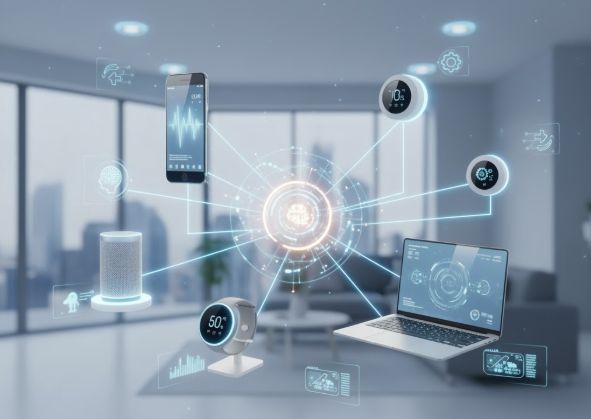
- Take the phone camera. A good shot used to depend on steady hands and the right settings. Now you point and press. The phone detects faces, balances light, reduces noise, and sometimes fixes motion blur. Night photos that used to be muddy come out clean because the phone quietly blends several frames and keeps the sharp parts. You get the credit when you post, but the hard work happens in the background.
- Voice assistants are another quiet shift. You don’t have to bark stiff commands anymore. You can speak naturally. Ask to set a reminder, send a quick text, or check the weather for tomorrow morning. The assistant parses the request and handles the little steps you used to do by hand. Is it perfect every time? No. But the misses are fewer, and that trend matters.
- Then there’s battery life and performance. Phones now study when you open certain apps and when you don’t. They pause the ones you rarely use, tune the ones you use daily, and pre-load the stuff you always open at the same hour. It sounds small. It feels big at the end of a long day when you still have charge.
Smart devices around the house follow the same logic. Thermostats learn your routine and dial the temperature up or down without waiting for a tap. Lights come on when you get home and dim at night. Security cameras spot a shape, decide if it looks like a person or a tree, and only send a useful alert. A speaker remembers the station you like in the morning and the playlist you use when you cook. None of this is dramatic. It’s a pile of tiny conveniences that add up to comfort.
Real-world examples you actually see
ChatGPT is the most obvious example in people’s minds right now because it helps with writing, planning, and learning. You ask a question and get a clean answer or a first draft to polish. That is AI making knowledge easier to reach.
Alexa and Google Assistant sit in kitchens and living rooms. They set timers, announce calendar events, and control lights. They don’t need instructions printed on a card. You talk; they handle it.
Cars use AI for driver assistance. Lane keeping, automatic braking, smarter navigation, warning beeps when a motorcycle hides in a blind spot. For many drivers, this is the difference between a scare and a safe stop.
Wearables like Apple Watch and Fitbit track sleep, steps, and heart rate. They notice patterns a person might miss. If something looks off, you get a gentle prompt. It is not a diagnosis, but it is a nudge to pay attention.
Automation and daily convenience
Automation used to mean a simple script. Today it means the system figures out the next step the way a person would
- . Your email separates promotions from personal notes.
- Your photo library sorts by people and places.
- Your phone groups trip details in one view with the flight, the hotel, and the check-in time.
- A small business can set up a chatbot that answers basic questions 24/7 and hands a tricky one to a human with the context already organized.
- A store can predict what might sell this month based on last year and last week, not just guess.
The win is not only speed. It is fewer mistakes. It is fewer boring tasks for a person who would rather solve a real problem than click the same button fifty times a day.
Impacts on healthcare, education, and business
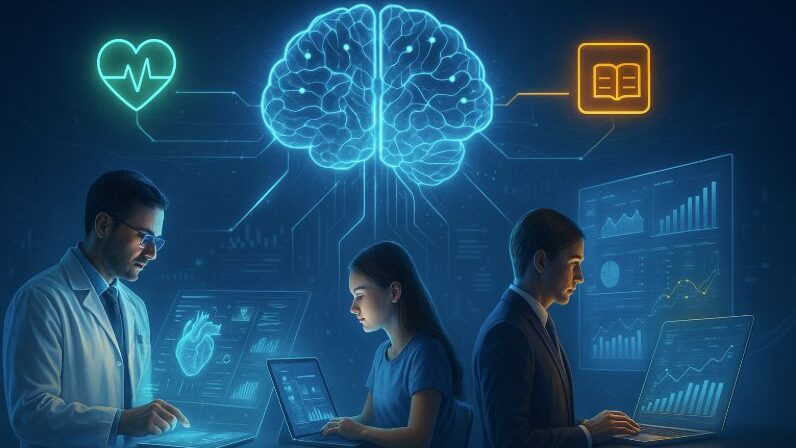
In healthcare, AI supports early detection. Systems read scans and flag areas a doctor should check again. Predictive models look across thousands of cases and suggest treatment options that fit a specific patient’s profile. Doctors still decide. AI helps them decide faster and with a broader view.
In education, the best use is personalization. Not every student learns at the same pace. Software can notice where someone slows down and offer a different example or an extra step. A teacher gets better insight into who needs what, instead of guessing from a pile of grades.
In business, AI helps in three places: understanding customers, forecasting demand, and spotting fraud. A team can see which product pages people hover on, which questions support hears most, and where the checkout breaks. They can adjust before a small problem becomes a big one. Finance teams use anomaly detection to catch odd patterns. Marketing uses prediction to spend budget where it works.
Even in fields like farming and logistics, AI adds value. Sensors in a field track moisture and growth. Routes update in real time for delivery trucks. It is not glamorous, but it saves fuel, reduces waste, and gets goods where they need to go faster.
Future possibilities and the questions we have to ask
The future everyone pictures is self-driving streets, fully connected homes, and AI that understands tone as well as words. Parts of that are already here in limited ways. We can expect smarter cities that adjust traffic lights to reduce jams and cut idle time. We can expect more preventive care where your watch and phone warn you early and share data with your doctor in a way that respects your consent. We can expect better translation that keeps the meaning and the style of what you said, not just the literal words.
But the future is not only about what is possible. It is also about what is wise. Privacy matters. Most of these systems work best with personal data. That data should stay protected, clearly explained, and under user control.
People should be able to see what is collected, delete it, and opt out without pain. Bias matters too. AI learns from data, and data can reflect unfair patterns. Teams need checks, audits, and diverse tests so systems treat people fairly. Jobs will change. Some tasks will move to machines. New roles will appear that need human judgment, empathy, and design. We should plan for training, not just talk about disruption.
Regulation will play a role, but the basics are simple. Be clear about what you collect. Ask before you use it. Keep it safe. Give people real choices. Build systems that explain their decisions in plain language. If a model denies a loan or flags a transaction, a person deserves to know why.
A practical way to use AI wisely right now
If you run a small website or store, start with three uses.
- Use AI to answer common questions and route the rest to a person.
- Use AI to summarize long feedback so your team can act faster.
- Use AI for content drafts but make a human edit ruthlessly. Readers can feel the difference. Keep your voice. Keep your examples. Keep your point of view.
If you are a regular user, set your devices up with intention. Turn on features you want. Turn off the ones you don’t. Review privacy settings once a month. Teach your photo app who is who so you can find memories in two seconds. Use focus modes so your phone respects your time. Let the smart thermostat learn, but set a hard range you’re comfortable with. These are small, human choices that make the technology serve you, not the other way around.
Humans and technology moving forward together
AI is good at patterns, not purpose. People bring purpose. A system can rank options. A person picks the goal. That is why the best results happen when humans and machines work side by side. You describe what matters. The system crunches the numbers. You decide what to do next.
I like to think of AI as a careful assistant with a good memory. It watches, suggests, and takes care of repetitive chores. It does not know your values. You do. Keep that line clear and the tools become less scary and more useful.
Conclusion
Artificial intelligence and smart devices have changed technology by changing our expectations. We expect a camera that handles a dark room. We expect maps that reroute in seconds. We expect a watch that cares if our heart rate spikes during a quiet afternoon. The bar is higher, and that is fine. These tools are here to help.
The next steps are not only technical. They are personal. Set your preferences. Learn your settings. Ask what data a service needs and why. Reward products that explain themselves clearly. When people stay involved, AI stays grounded. It becomes less of a headline and more of a daily helper.
So yes, the future is smart. But it should also be simple, respectful, and human. If we keep those three words in mind, the tech we carry and the homes we build will feel less like machines and more like good tools in steady hands. That is the future worth aiming for, and it starts with the choices we make today.
#SWI